
Federal Union County Release Paths
The Federal Bureau of Prisons runs the sentenced federal prison system. It is separate from Union County Jail and MDOC. A federal defendant from Union County may enter BOP custody after judgment and designation to a facility in another state. The county roster does not follow that placement.
A past BOP release date can show the end of federal prison custody. The result may say “Released” or “Not in BOP Custody.” That does not rule out federal supervised release, state or local custody, or immigration detention. An older federal parole case may also have supervision. Treat BOP departure as one agency's exit, not a universal declaration of freedom from custody.
Search Federal Union Releases
The official BOP Inmate Locator searches federal records from 1982 forward. It supports a name search and identifier search. A federal register number is the best discriminator when known. Name results show age, race, sex, release date, and location information.
- Search by register number when available, or enter the full name with careful spelling.
- Compare identity fields before opening or relying on a result.
- Read the location and release-date fields together.
- If the date is past and no facility is listed, review BOP's explanation of past release records.
- Check the federal judgment for the sentence and any term of supervised release.
- Use BOP records or the relevant federal agency when the locator result is incomplete.
A no-match result can have several causes. The person may be a federal pretrial detainee held for USMS, may use a different name, may have a pre-1982 record, or may never have entered BOP custody. Do not translate “not found” into “released.”
Read BOP Release Results
BOP explains how to interpret its historical locator fields. When a date is in the past and the result has no current facility, that date can establish that BOP custody ended. A future date is projected and can change. BOP specifically notes that First Step Act recalculations may affect a displayed future release date.
| Locator result | Careful interpretation |
|---|---|
| Current facility listed | The person remains in BOP custody at the listed location |
| Future release date | A projected federal date that may change |
| Past date and “Released” | BOP custody ended on the listed date |
| “Not in BOP Custody” | BOP does not currently hold the person |
| No match | The query found no matching BOP locator record |
The BOP record explanation is the official source for reading past dates.
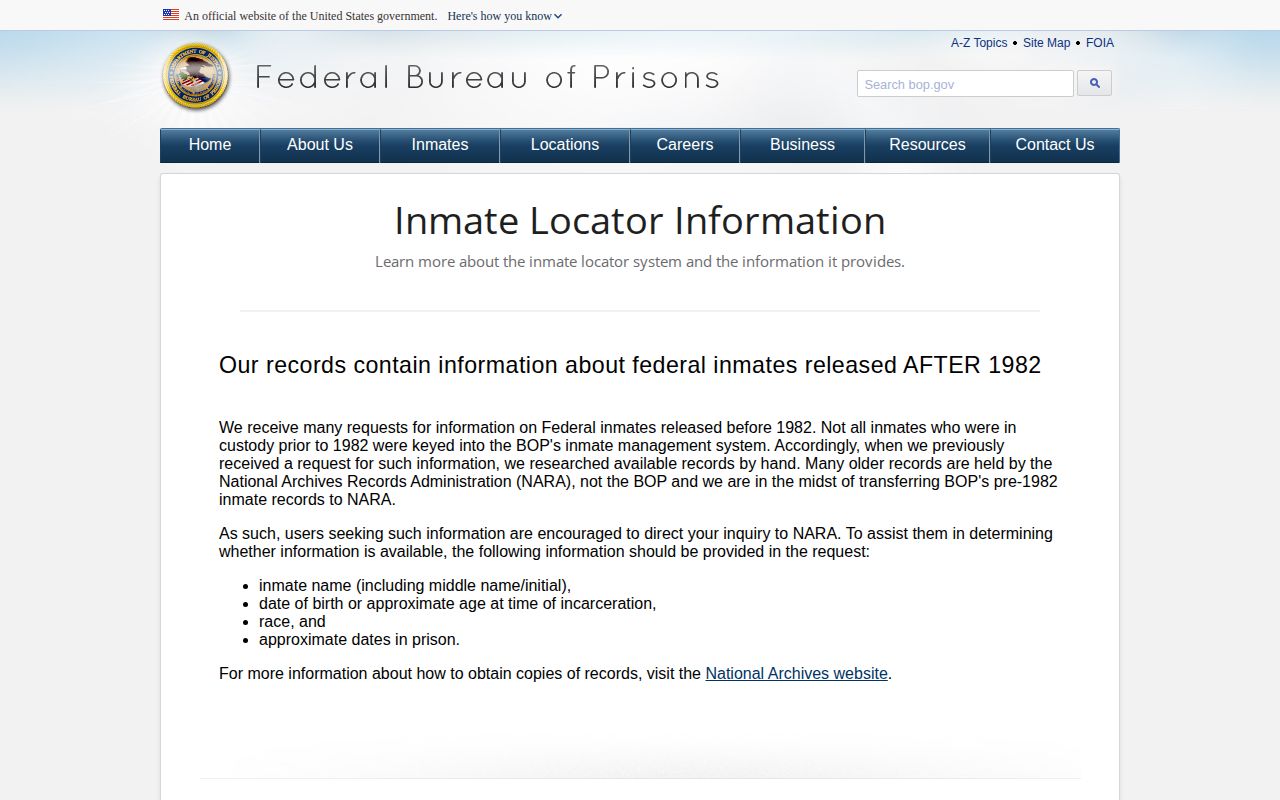
The source view shows why the date and custody label must be read together. It does not show whether another agency later took custody.
Federal Pretrial Union Custody
The U.S. Marshals Service custody guidance explains the federal pretrial role. A defendant may be held in a local or regional contract jail and remain absent from the sentenced-prison locator. A federal writ can also move a person temporarily from state or county custody for court.
Search the federal court docket for the charging district and identify the handling USMS district. Ask prisoner-services staff about the correct public location route. A Union County jail record that says USMS or a federal agency accepted the person should be labeled a transfer, not a release to the community.
BOP designation often follows sentencing. The time between a county or regional exit and a BOP posting can create a gap. The federal commitment, USMS information, and later BOP record should form a continuous custody chain.
Note: BOP's locator is built for federal inmates, not every person held pretrial or temporarily for the U.S. Marshals Service.
Request Federal Release Records
The locator gives a useful public summary, but it is not the full release file. For more detail, submit a records request to BOP under federal FOIA procedures. Identify the person by full name and register number. Ask for the public portions of admission, transfer, and release information rather than broad confidential institutional materials.
The federal court docket supplies the judgment, amended judgment, commitment, sentence, and supervised-release term. A release date in BOP and a supervision term in the judgment can both be true. The probation office, not BOP custody staff, handles federal supervised release after imprisonment.
BOP's public locator does not display photographs. Identity should be checked with the register number and court record. Do not borrow an MDOC photo or Union County booking image and label it as a BOP record.
Federal Facilities Serving Union
No BOP prison was identified within Union County. There is therefore no local BOP release desk or Union County federal facility address supported by the research. Search nationally by name or register number, then use the location shown in the result.
Nationwide correctional system
Official lookup: BOP Inmate Locator
Search by name or federal register number
The locator facility name directs contact for a current prisoner. For a released person, use the historical result, federal court file, and appropriate BOP records process. For a pretrial person, route through the relevant USMS district.
After Federal Union Release
BOP departure may be followed by supervised release, state custody, local custody, or immigration detention. The federal judgment identifies supervised release. A state or county warrant may cause a handoff. ICE may take custody based on immigration authority. None of those later statuses is resolved by the BOP line alone.
If the BOP result shows a past date but the person cannot be located, check the federal docket for release conditions and later violations. Search MDOC or the relevant local jail when a state hold is known. Use ICE ODLS when a federal or local record names immigration custody. Follow evidence, not assumptions about citizenship or status.
- BOP release
- The federal prison agency ends custody.
- Supervised release
- Court-ordered federal supervision after imprisonment.
- USMS custody
- Federal pretrial, transport, or court-related detention authority.
- Detainer
- Another agency asks to receive or continue holding the person.
Connect Federal and Union Records
A Union County connection may arise from a local arrest, a federal adoption of conduct, a detainer, or a separate federal case. The Union County Sheriff record can show when local custody ended and which agency received the person. The federal docket then shows the case and authority. BOP shows sentenced federal placement and a later federal release date.
Keep each event separate. “Released by Union County to USMS” means the Sheriff stopped holding the person while federal custody continued. “Released by BOP” means federal prison custody ended. Neither phrase alone shows that every other hold or supervision term ended.
Use the Union County released-inmate search when the first custodian is unclear. It routes a named person through county, MDOC, VINE, court, BOP, and ICE sources without presenting one system as complete.
Federal Union Release Proof
The strongest confirmation combines the BOP locator with a durable federal record. Preserve the name, register number, exact custody label, release date, URL, and time checked. Obtain the judgment when supervision or sentence terms matter. Request BOP records when the public result lacks needed detail.
A current Union County roster cannot confirm a past federal release. MDOC cannot confirm BOP custody. Likewise, BOP cannot certify an ICE release or state discharge. Use the agency responsible for each segment of the chain.
Label uncertain results honestly. “Not found” is a search result. “BOP custody ended” is supported by a past date and official status. “Transferred” requires a receiving agency. “Community release” needs evidence that the exit was not merely another custody handoff.
Federal register numbers reduce false matches. Preserve the full identifier from the locator and compare it with the judgment or commitment record. Similar names, aliases, and spelling differences can otherwise produce the wrong person, especially in a nationwide database.
If a future date passes while the locator still lists custody, do not infer that BOP failed to release the person unlawfully. Recalculation, a new judgment, disciplinary time effects, or another lawful change may be reflected later. Ask BOP for the public explanation and current record.
A federal release date should also be compared with the judgment's supervision term. Supervised release starts after imprisonment under the court's order and is not BOP confinement. A later violation can lead to a new court action and custody episode, so keep the original release and any return to custody as separate events.
BOP Historical Record Limits
The BOP locator's public coverage begins in 1982. A federal custody event before that year may require a court file, archived agency record, or focused federal records request. Failure to find an older name in the locator cannot establish release.
For later records, keep the register number with each saved result. It ties a past release date to the correct federal record even when names have changed or several people share the same name.